
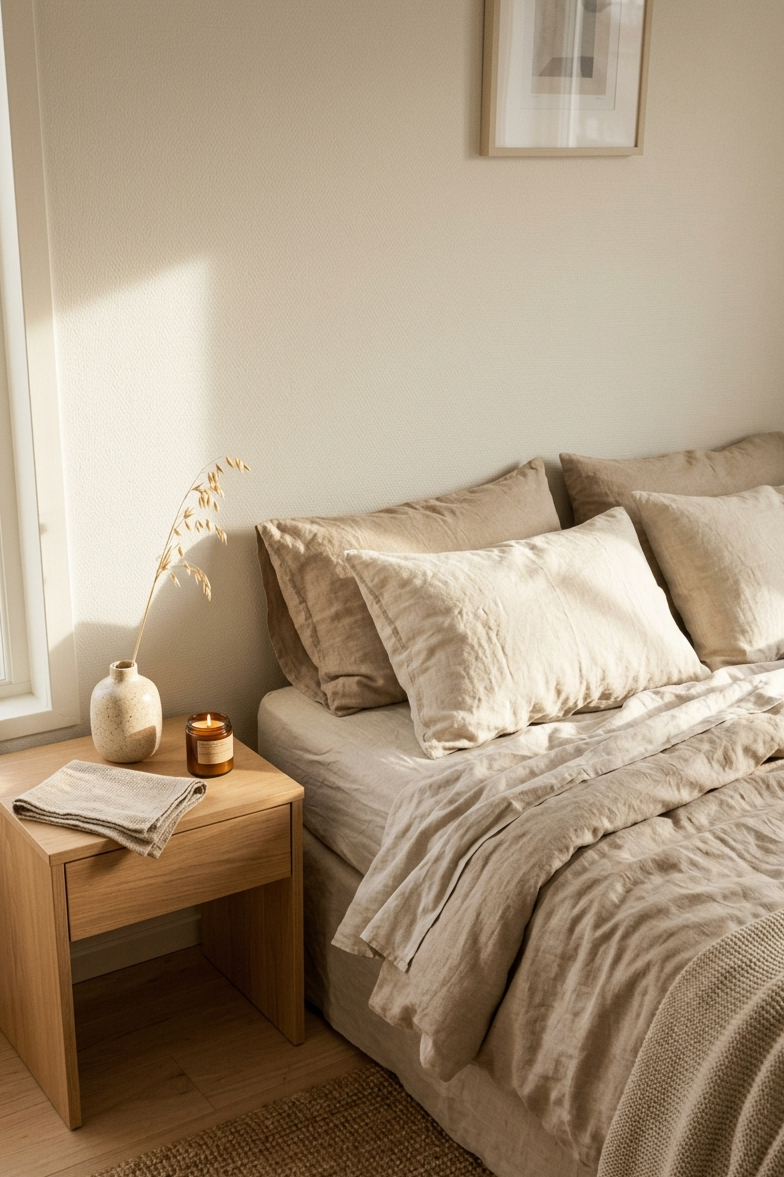
The room in every home that gets the least attention and needs it the most. The bedroom.
We spend a third of our lives in there, but when it comes to decorating, it’s usually the last room we get to. The living room gets the nice throw pillows. The kitchen gets the new pendant light. The bedroom gets… whatever’s left.
And then we wonder why we don’t sleep well, why the room never quite feels settled, why it looks fine in photos but feels vaguely wrong to be in.
I’ve been thinking about this a lot lately, and I think the problem isn’t budget. It’s usually a handful of small decisions — framing, height, texture, contrast — that quietly make a bedroom feel either restless or calm. None of them require a renovation. Most of them don’t require spending anything at all.
These are the changes that actually make a difference.
(This post contains affiliate links. As an Amazon Associate, I earn from qualifying purchases at no extra cost to you.)
Start with the wall above the bed — it’s doing more work than you think
The wall above the bed is the first thing you see when you walk into most bedrooms. It sets the entire mood of the room before anything else registers.
The most common mistake: hanging one small frame in the middle of a wide wall. It floats there, disconnected, making the whole room feel unfinished.
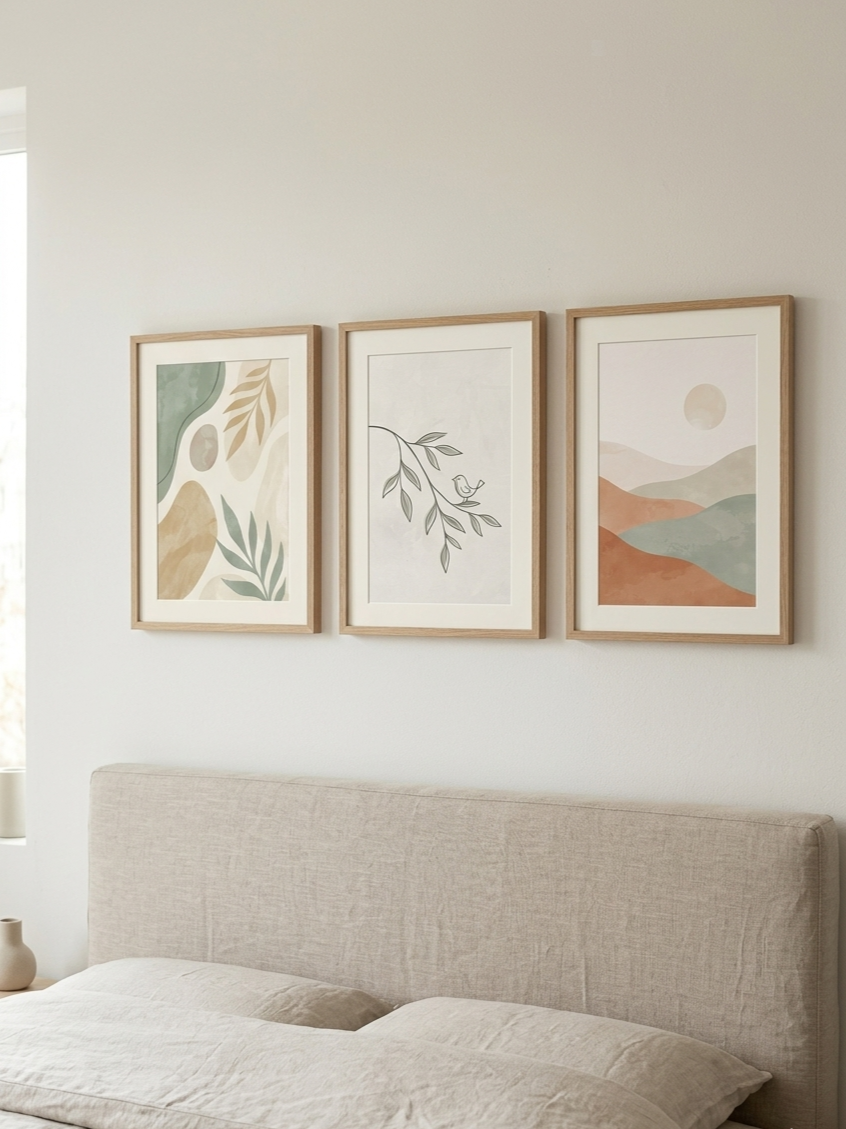
The principle that works better is the two-thirds rule — whatever you hang above the bed should span roughly two-thirds of the headboard width. So if your bed is 160 cm wide, the art should visually cover around 100–110 cm.
That can mean one larger print, or a set of two or three smaller ones arranged together with a small gap between them. A set of three coordinated prints in light oak frames almost always looks more intentional than a single small frame, because your eye moves gently across them instead of getting stuck in one spot.
Height matters too. Most people hang art too high. Try centering it about 15–20 cm above the headboard, which is lower than you’d instinctively go. When it’s closer to the bed, the whole composition feels grounded instead of floating.
One wood tone, not several
Walk into a bedroom that feels calm and look at the materials. You’ll almost always find that the wood tones match — or at least stay in the same family.
When the bed frame is dark walnut, the frames are blonde oak and the bedside table is painted white, your brain registers all of it as competing noise, even if you can’t name what’s wrong.
Picking one wood tone and repeating it quietly — in the bed frame, the shelving, the picture frames, maybe a small wooden tray on the nightstand — is one of the easiest ways to make a room feel coherent. Light oak frames are probably the most versatile choice for neutral and Japandi-style bedrooms because they work with almost every wall color and furniture tone.
Rethink the bedside table
The bedside table is where most bedroom clutter lives.
A lamp, a phone, a book, a glass of water, a charging cable, a lip balm, a receipt from three weeks ago.
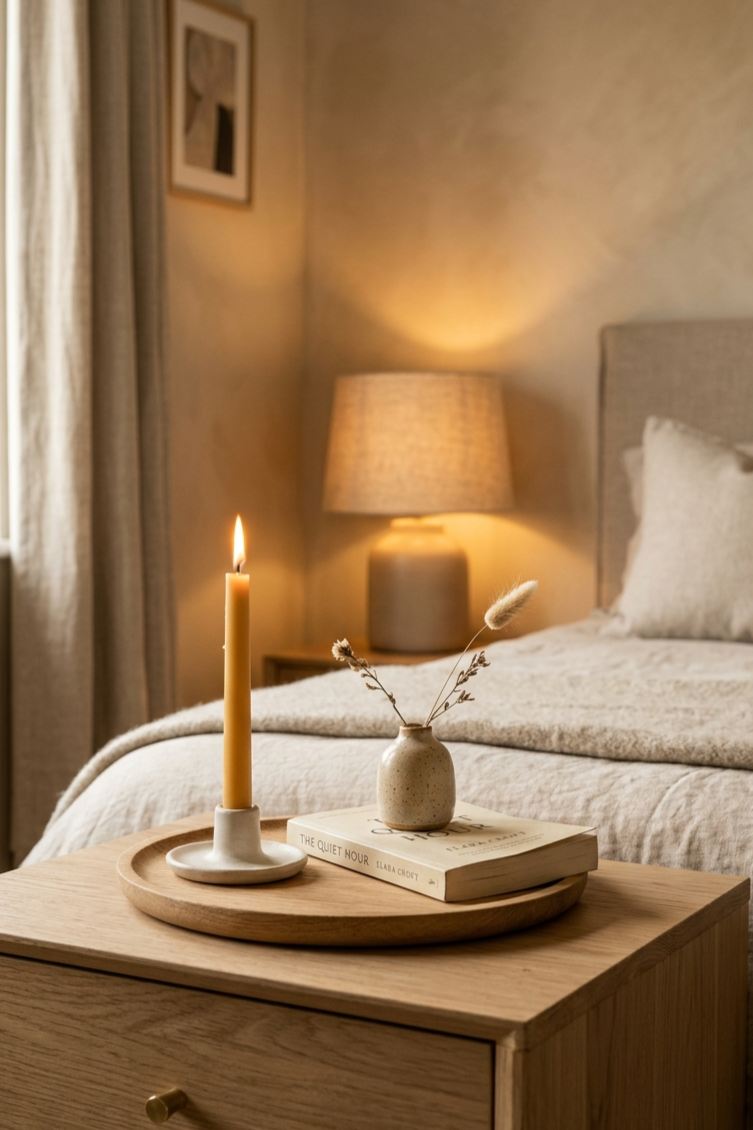
The simplest fix is a small tray. Not to contain the mess, but to give the “kept” items a boundary. A small wooden or ceramic tray signals that everything inside it is intentional. A candle, a book, a small plant. Three things. The tray becomes a quiet focal point instead of a dumping ground.
If the lamp itself is adding visual noise — too many cords, too industrial, too bright — a simple linen shade table lamp in a warm tone makes an enormous difference to how the room feels at night. Warm light at low height is one of the fastest ways to make a room feel restful.
Soft contrast instead of stark contrast
High contrast — bright white walls, dark furniture, bold patterns — can look good in photos and feel exhausting to sleep in.
Calm bedrooms usually work with softer contrast. Warm white or sand tones on the walls. Linen bedding in natural ecru. A sage green cushion. A terracotta throw.
The colors are different enough to be interesting, but close enough in tone that nothing shouts for attention.
If your walls are already a neutral white or warm beige, you’re most of the way there. Adding one textured linen cushion in sage or clay can be enough to make the room feel layered and complete without touching anything else.
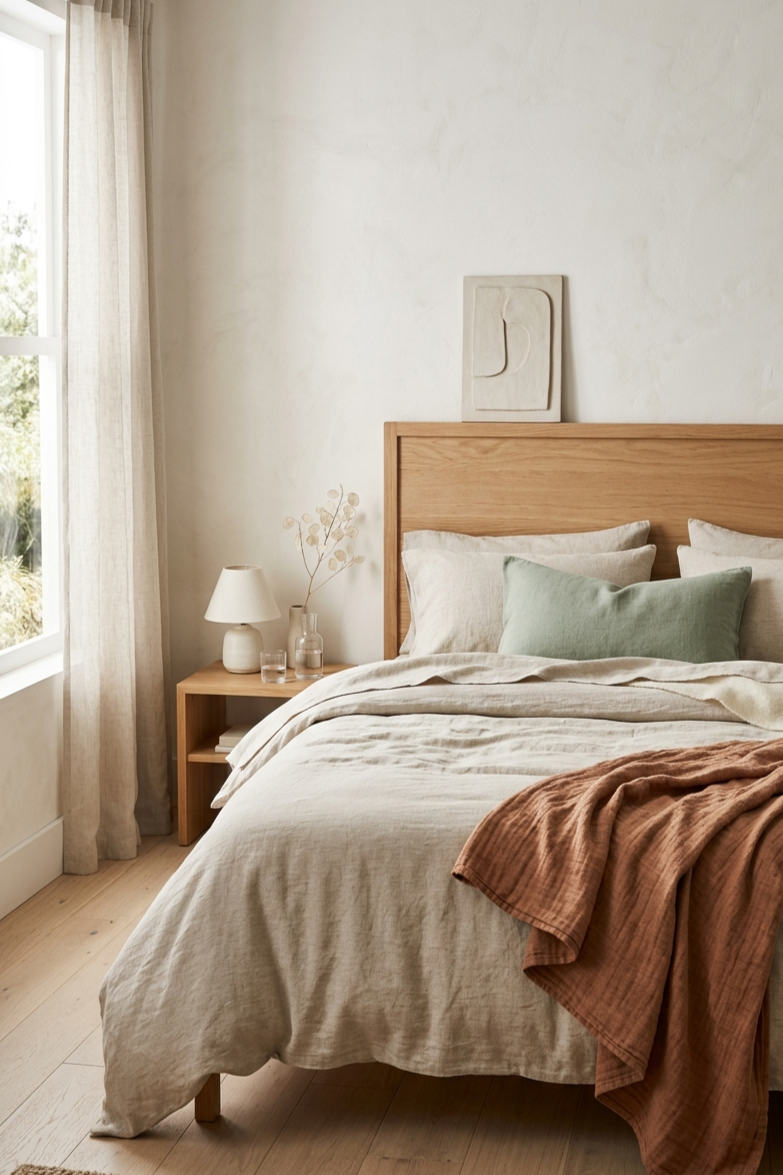
For the art, the same principle applies. Soft watercolor textures, muted abstract shapes, gentle earthy tones — they add visual interest without creating the kind of contrast that wakes your nervous system up. If you want something to start with, you can download a free printable nursery set here — the soft sage and terracotta palette works beautifully in adult bedrooms too, especially above a dresser or in a reading corner.
The linen rule
If there’s one material that consistently makes a bedroom feel more peaceful, it’s linen.
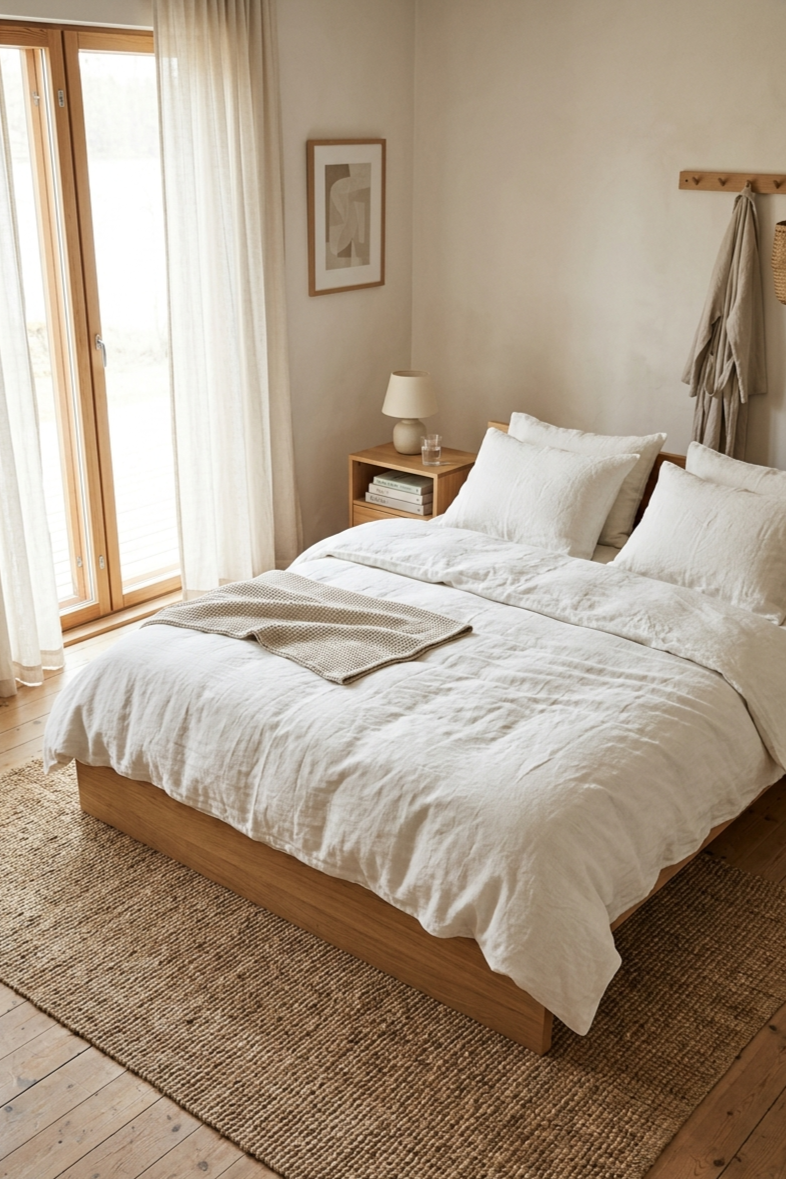
Linen bedding, linen curtains, linen cushion covers. It has a softness that looks lived-in rather than staged. It wrinkles in a way that looks intentional. It feels cooler in summer and warmer in winter than most alternatives.
It’s also one of the most affordable swaps you can make. A linen duvet cover in natural white or oatmeal costs roughly the same as a standard cotton one, but the difference in how the room looks and feels is significant.
Paired with a natural fiber rug beside the bed — jute, seagrass, or a simple wool flatweave — you start to build a room that feels grounded and tactile rather than flat and polished.
The small shelf test
A bedroom with too much furniture feels smaller. A bedroom with only furniture feels impersonal.
The middle ground is one small shelf — usually on the wall beside or above the bed, at a height that feels intentional rather than crammed in.
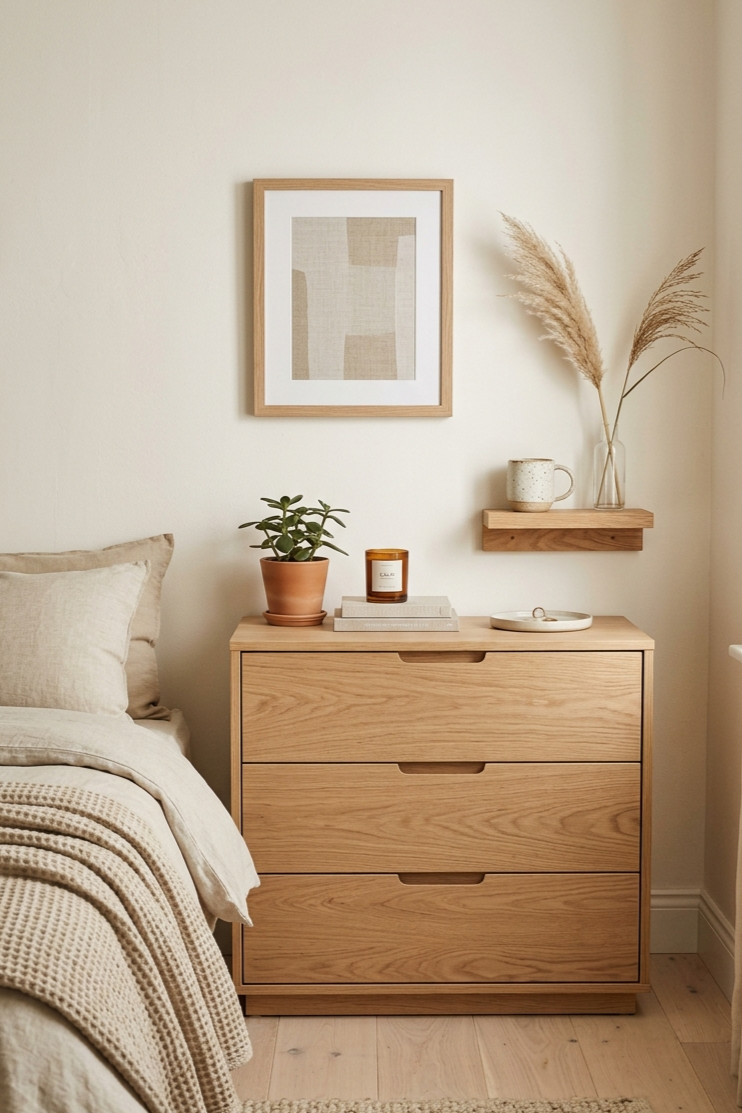
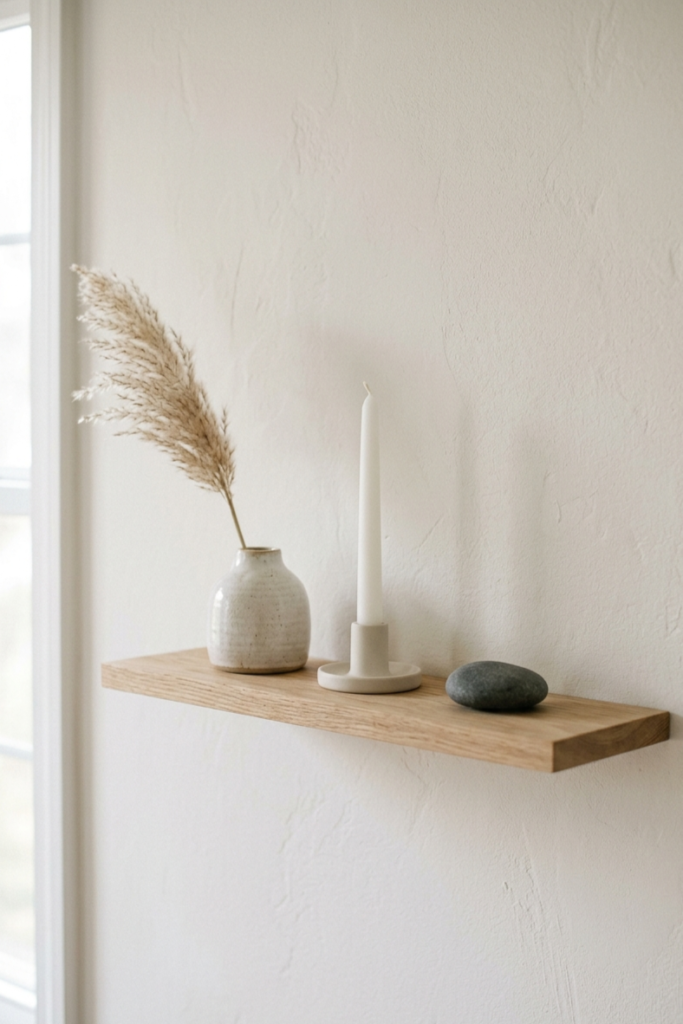
On that shelf: three things. A small ceramic vase, a candle, and a book. Or a small plant, a framed photo, and a stone. The rule of three works here for the same reason it works everywhere in calm interiors — three items feel collected and intentional, while two feel accidental and four start to look crowded.
The shelf itself should be simple. A thin oak floating shelf disappears into the wall and lets the objects on it do the work.
What about empty space
The instinct when a room feels unfinished is to add more.
More cushions. Another candle. A different rug. One more print.
But calm bedrooms are usually built around what’s been deliberately left out. An empty wall beside a window. A bare corner with only a floor lamp. Enough space around the bed that you can move through the room without feeling hemmed in.
Negative space isn’t an oversight. It’s the part of the room that lets you exhale.
If your bedroom currently feels restless and you’re not sure why, try removing one thing before adding anything new. Take away a cushion, a small decor item, a piece of art that isn’t earning its place. See if the room feels lighter.
It usually does.
The overall idea
A calmer bedroom isn’t really about the specific items you choose. It’s about reducing the number of decisions your eye has to make when it moves around the room.
One wood tone. One color family. Art at the right scale and height. Surfaces with breathing room. Materials that feel natural and soft.
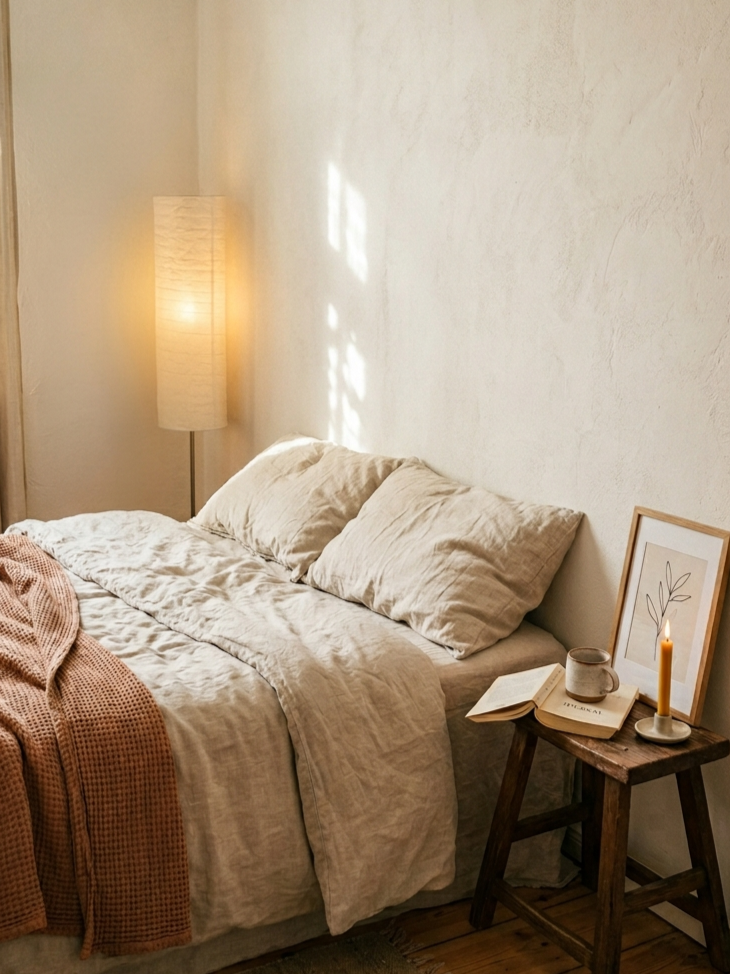
None of these things require a renovation or a large budget. Most of them just require noticing what’s creating visual noise and quietly removing or replacing it.
The bedroom should be the easiest room in the house to be in. With a few small adjustments, it usually can be.
If you’re looking for calm, minimal wall art for your bedroom or nursery, you can browse the full collection at Peaceful Mind Living on Etsy. And if you’d like to try a free set before committing to anything, the free printable wall art is a good place to start.