
(This post contains affiliate links. As an Amazon Associate, I earn from qualifying purchases at no extra cost to you.)
There is a specific kind of dissatisfaction that is hard to explain. The room is fine. Nothing is wrong with it. But it does not feel the way you want it to feel.
Most people respond to this by adding things. A new cushion. Another plant. Some artwork they find online. And the room still does not feel right, because the problem was never about what was in it.
Often, the problem is the windows.
Not the view, and not the light itself. The curtains — or the absence of them, or the wrong version of them. It is one of the most overlooked surfaces in any room, and one of the most powerful.
Swapping to linen changes that almost immediately.
Why curtains matter more than most things
A curtain covers a large portion of a wall. It moves. It catches light differently at different times of day. When the fabric is wrong — too shiny, too stiff, too thin, too heavy — the eye registers it even if the brain does not name it. The room feels slightly off without a clear reason why.
Linen is the material that tends to make that feeling go away.
It is not a trend. Linen has been used in homes for centuries, for practical and aesthetic reasons that still hold. It breathes. It softens with washing rather than degrading. It drapes in a way that looks relaxed without looking neglected. And in a room designed around calm — Japandi, Scandinavian, slow living, neutral, any of them — it fits without effort.
The effect is immediate and surprisingly significant for a single change.
What linen actually does to a room
It filters light without blocking it
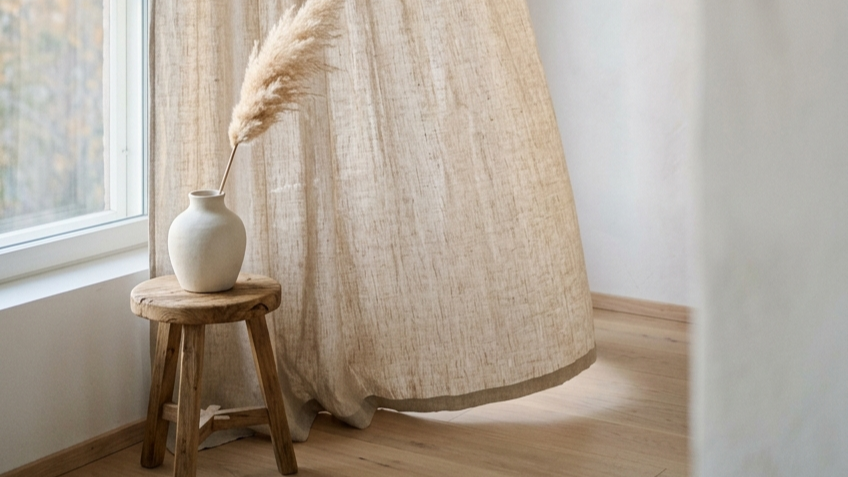
Linen is a naturally semi-opaque fabric. A good linen curtain lets daylight through in a way that diffuses it — softening it, warming it slightly, spreading it more evenly across the room. The effect is closer to the light inside a Nordic home in winter than the hard-edged light that comes through bare windows or thin polyester panels.
In the morning especially, the difference is striking. The room does not get dark. It gets quieter.

If privacy or blackout is a concern, linen can be lined. But even unlined, most linen curtains give enough privacy for living rooms and common spaces while preserving that quality of filtered light.
It adds texture without adding colour
One of the tensions in minimal interiors is that reducing objects also reduces visual interest. Linen solves this without requiring colour. The natural slub of the weave, the slight irregularity in the surface, the way it catches light from different angles — all of this creates texture that the eye finds restful to look at.
A warm natural linen in oat, flax, or undyed ivory works in almost any neutral palette. It brings texture without contrast, and softness without warmth you have to manage around.
It makes the room feel taller
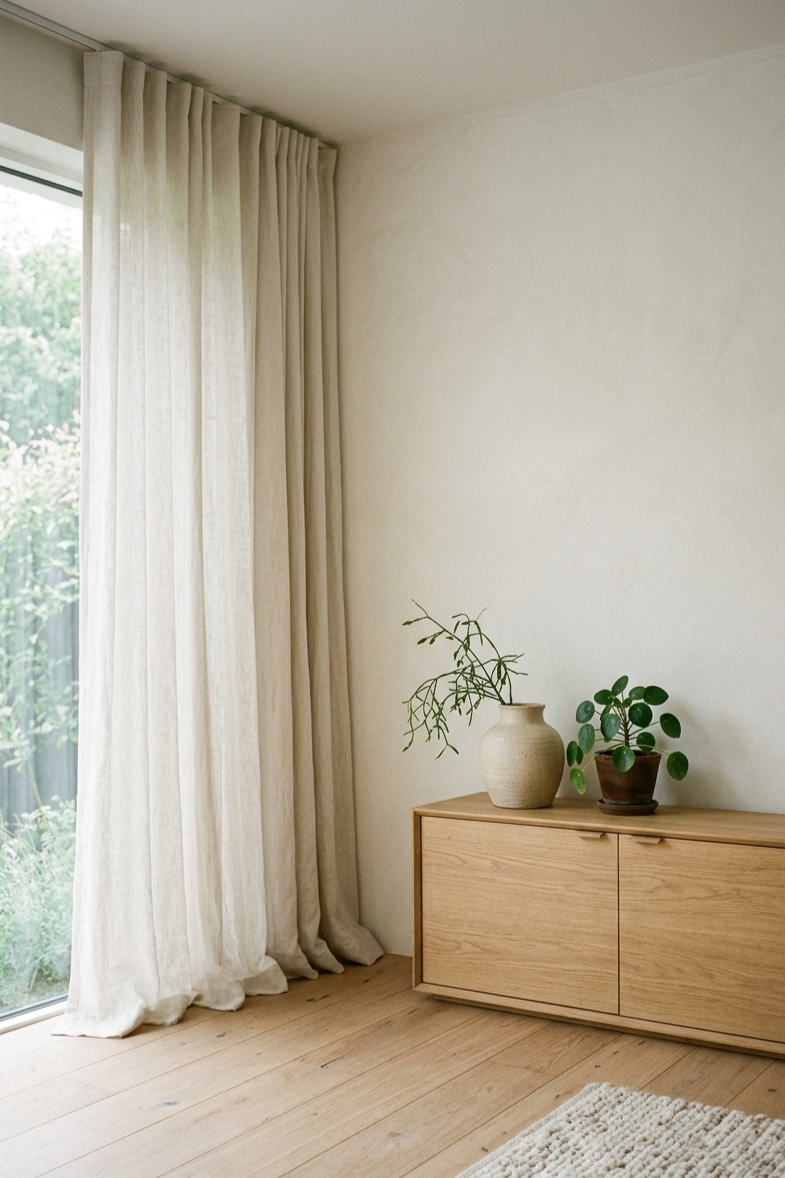
Hung correctly, linen curtains extend the visual height of a room in a way that almost no other change achieves. The key is to hang them close to the ceiling and let them reach the floor. Most curtains are hung at window height, which cuts the wall visually in two. Hung high, even in a room with standard ceilings, linen curtains pull the eye upward and make the whole space feel more generous.
This is a technique borrowed from interior designers who use it consistently, and it costs nothing extra. The curtain just needs to be long enough.
Choosing the right linen curtains
Colour
Natural undyed linen is the safest starting point. It reads as warm rather than cool, which makes it compatible with wood tones, clay plaster walls, jute, and most of the materials common in calm, minimal interiors.
If the room already has cool tones — grey walls, stone surfaces, blue accents — a slightly lighter or more bleached linen will bridge the gap without adding warmth that fights the palette.
Off-white and oat are the two shades that tend to work everywhere.
Weight
Curtain linen varies significantly in weight. For most rooms, a medium weight is ideal: heavy enough to hang with shape and drape with some body, light enough to still move and to let daylight through. Very light linen can look limp once hung. Very heavy linen can feel more like a room divider than a window treatment.
Look for curtain linen described as medium weight, around 200–270 gsm if the listing includes it.
Length
The curtain should reach the floor. Ideally it should puddle very slightly — two or three centimetres touching the floor — which gives the drape a softness that short curtains do not have. This is the detail that makes linen curtains look considered rather than functional.
If you are after something cleaner, a break of about half an inch above the floor also works. What does not work is the curtain hovering above the floor. It looks unfinished and undoes a lot of the effect.
Tabs, rings, or rod pocket
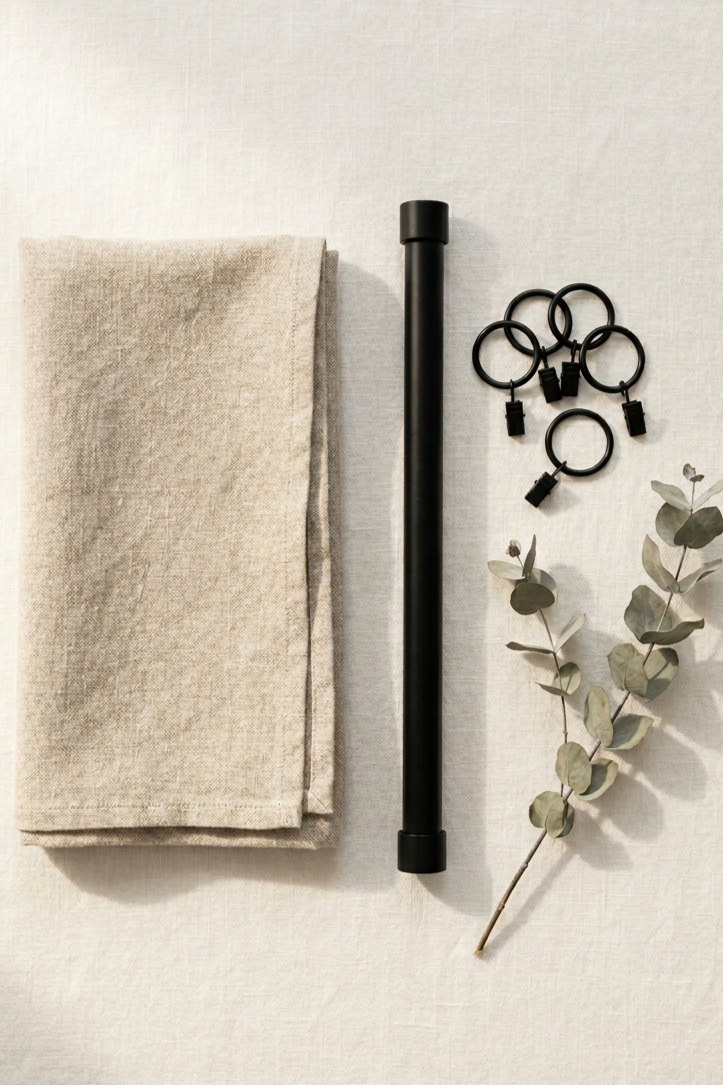
Eyelet curtains are common and practical, but the eyelets themselves can look industrial in minimal rooms. For a cleaner look, curtains with fabric loops (tab top) or hung on matte black or antique brass clip rings over a simple rod tend to sit better.
Clip rings also allow you to convert almost any piece of fabric or an unlisted curtain panel into a window treatment, which is useful if you find linen by the metre that you prefer to ready-made panels.
The rod matters too
A curtain is only as composed as the rod it hangs from.
Thin chrome rods from flat-pack furniture stores do a particular kind of damage to a calm room. The material is wrong and the diameter is too small to look intentional at full curtain width.
For a Japandi or Scandinavian-leaning room, a matte black curtain rod is the cleanest option. It recedes against the wall, holds the curtain without decorating it, and works with wood, stone, and neutral walls equally. A warm brushed brass rod works if the room already has warm metal tones.
Keep the finials simple. Flat disc ends or minimal cylindrical caps. The rod should not draw the eye.
Where linen curtains make the biggest difference
The living room
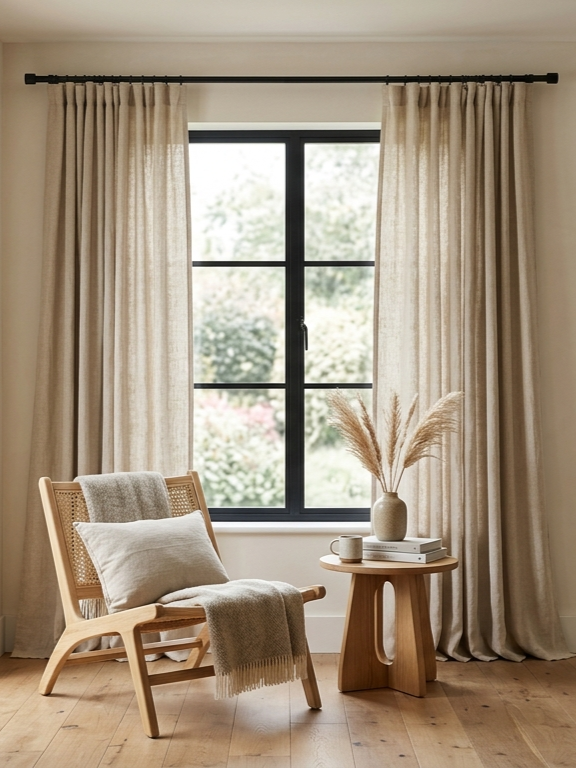
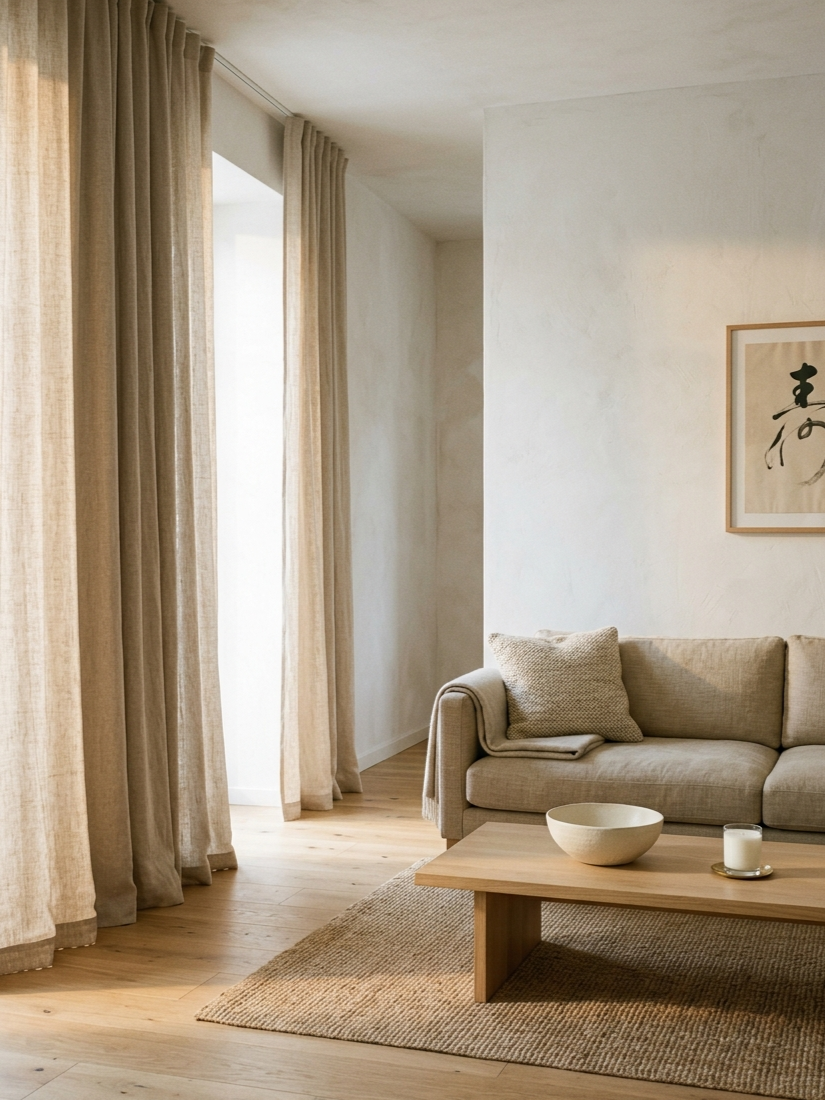
This is the highest-impact room for linen curtains because it is where natural light and the sense of the room’s atmosphere are most noticed. A living room with bare windows or thin curtains that catch every draught and billow visibly has a certain restlessness to it. Linen settles that.
One panel per window in a living room with several windows creates a rhythm along the wall. Two panels per window, drawn back loosely during the day, creates more volume and softness. Both approaches work — it depends on how much of the window you need to cover.
A simple linen curtain panel in natural or oat alongside a low wooden coffee table and a ceramic piece is the combination that most often produces that quality of calm that is difficult to articulate but very easy to feel.
The bedroom
The bedroom is the room where light quality matters most practically, because it affects sleep. Morning light is the main variable — and linen handles it better than sheers, which let everything through, and better than heavy blackout, which turns the room into a cave.
Linen filters. The room gets lighter gradually. It is enough to wake with naturally and enough to dim for sleeping, especially combined with a lined version.
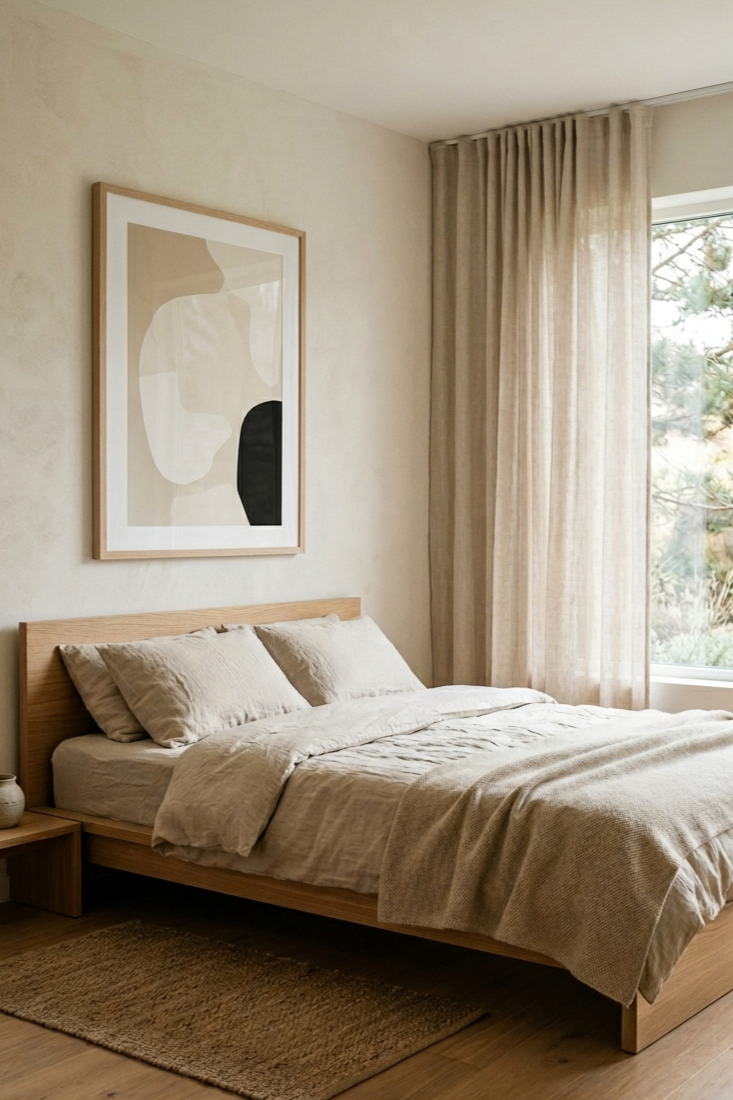
In terms of proportion, a bedroom with linen curtains hung from ceiling to floor changes its character almost completely. The room reads as more considered, more restful, more finished.
For the wall above the bed, a quiet piece of wall art in warm neutral tones keeps the whole composition settled. One or two calm prints alongside linen curtains is the combination that makes a bedroom feel genuinely like somewhere to rest rather than somewhere to sleep.
The home office or reading corner
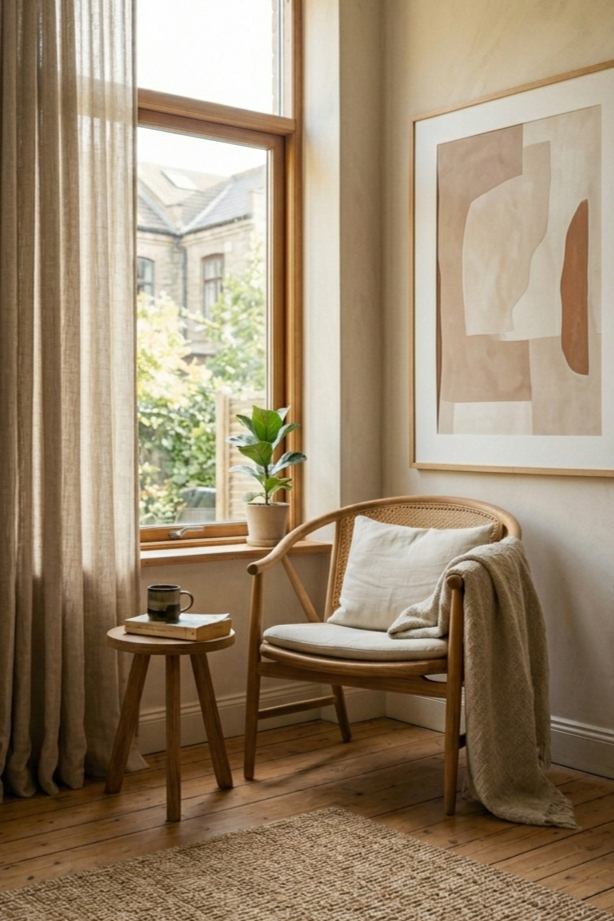
Light matters here too, but for different reasons. A room with linen curtains pulled slightly — not closed, just moved a few inches across the window — diffuses direct afternoon sun without losing daylight. It makes screens more readable and the room more comfortable to be in for long periods.
A simple reading corner with a warm lamp, a linen throw and linen curtains at the window is one of the most low-effort environments to build, and one of the most effective. The materials do most of the work.
A note on ready-made versus made-to-measure
Ready-made linen curtains are widely available and for most windows work well. The limitation is length — many standard drops stop at 228cm, which is fine for average-height ceilings but falls short if you want to hang closer to a high ceiling.
Made-to-measure linen curtains can be ordered through several online retailers and are more affordable than most people expect. If the windows are unusually sized or the ceiling is high, this is worth considering.
For most rooms with standard windows and ceilings around 240–260cm, a ready-made panel in the right width hung on a ceiling-mounted or high-set rod will work without alteration.
A few things that help
For anyone working on a window with this in mind, these are the pieces that make the most practical difference:
- Natural or oat linen curtain panels in medium weight — look for 100% linen or a high-linen blend
- Matte black clip rings — useful for both ready-made curtains and fabric panels
- A ceiling-mount or wall-mount curtain rod bracket — the detail that allows the rod to sit above the window frame rather than on it
- A simple matte black curtain rod in the right length — most rooms need two sections joined if the wall is wide
- A small hook or wall holder for a loose tieback — or a piece of natural rope tied simply around the panel
None of these are expensive. The total cost of the change is usually modest. The effect on the room is not.
The overall idea
Linen curtains are one of those changes that makes a room feel better in a way that most people cannot immediately name. They do not add colour or fill space. They change the quality of the light and the softness of the walls. They bring texture that is comfortable to look at. And hung correctly — high, long, slightly loose — they make any room feel taller, calmer, and more settled.
It is a single change. It tends to make everything else in the room look more considered too.
For calm, minimal wall art designed for Japandi and neutral interiors, you can browse the full collection at Peaceful Mind Living on Etsy. And if you are building a calm bedroom from scratch, this post on minimalist bedroom changes covers the other decisions worth making.